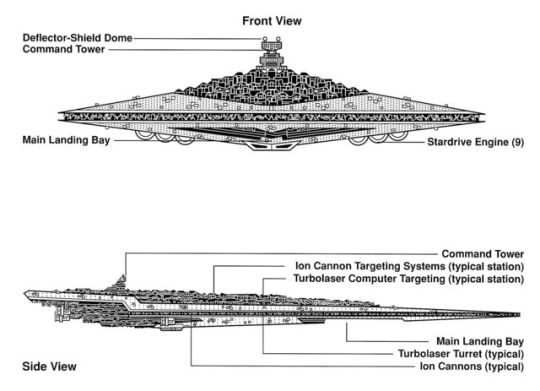
Do you know of any reference books that have detailed blueprints/cross-sections/images of the Executor? I’ve got a ton of reference books, but only one has any real detail on the Executor and it’s just the command tower (The Complete Locations, pre-TFA version). I’ve seen articles that mention blueprints for the ship, but I haven’t been able to track down where those might be found. Any help is appreciated!

I’m sorry, I’ve taken a look through my reference books and I’m running into the same problem. I don’t know of any detailed blueprints – perhaps because the ship is just so big, it would be very difficult to create a true blueprint for the entire thing. The most detailed image I could find is this, which I expect you’ve probably already found (from The Essential Guide to Vehicles and Vessels):

image

If anyone else would be willing to take a look in their books the help would be greatly appreciated!

~ Jacen

On the bridge(?) of larger starships what are the seats/stations called? And what are some of the functions? I’m also wondering when would a ship warrant a name vs just be referred to it by it’s make and model? How do call signs work? It seems like it’s function is to facilitate communication but it’s not clear how they get assigned (thinking of that scene in Rogue One) and that they may or may not be related to the ship’s name?

As larger ships need more personnel to function fully, they usually have bridges with a number of console stations as opposed to a cockpit. The layout of the bridge and what specific stations will be on it will depend on the ship and its capabilities; the most famous of them would of course be the typical Star Destroyer’s bridge, featuring a central command walkway with two crew pits on either side. 

Unfortunately, as I have just discovered after a surprising amount of digging, the different stations don’t seem to ever be properly defined, for a specific ship or as a general rule. I can tell you that a typical bridge will have communications, navigation and astrogation stations. On warships, the bridge will have stations for gunners. On ships with tractor beams, such as Star Destroyers, there will be people on the bridge able to operate them, possibly with the support of other people working nearer the tractor beams (it is unclear exactly how these are controlled). In Lost Stars there is a scene where an Imperial bridge officer gives navigational assistance to TIE fighters attempting to fly through an asteroid field, directing them to change course when needed; hence, there are officers capable of accessing tracking and sensor data. 

Whether all these functions are carried out by different officers at separate stations is a bit unclear. According to the one diagram I managed to find of an Imperial bridge (from an old d20 sourcebook), weapons and communications are actually taken care of in separate areas, outside the crew pit. This doesn’t seem to be the case in new canon, but I believe that weapons, communications, navigation and astrogation would still have their own dedicated console stations, because they are more specialized and complex tasks. This specific subject isn’t well covered, so you’ve got plenty of freedom to interpret as you will. 

As for names: generally, larger ships will get names, starfighters will not. Naming a ship is a sign of personalization, so names as opposed to designations are much more common among private spacers and organizations that allow a degree of attachment to the ships. The Rebels, for example, named a lot of their ships, and referred to them by that name, with the exception of the starfighters. The Imperials named only significant ships, ones where a name would add to the ship’s intimidation factor: capital ships, flagships, and ships used personally (often exclusively) by high-ranking officers. Small ships other than starfighters – gunships, shuttles, etc. – don’t usually get names. If a ship is owned personally by someone, it almost always gets a name; this means tramp freighters, yachts, re-purposed/stolen military vessels, and the like. Basically, just use your judgement; if the ship is unique and important, it probably needs a name. 

In almost every case, if the ship has a name then the pilot/captain/crew will not have call signs. Call signs are usually given to the pilot of a one-person ship, typically a starfighter flying as part of a squadron. They are assigned based on the pilot’s squadron, and often follow a numerical pattern: Red Squadron might consist of the pilots Red One, Red Two, Red Three, Red Four, etc. Hence, every pilot gets a unique name that also identifies their squadron. This was common practice in the Alliance and New Republic, and though call signs also followed this pattern in the Grand Army it seems that the clone pilots often preferred to call each other by name. Imperial call signs followed very specific guidelines, so here is the article on that. If a communications officer needed to give instructions to a ship with multiple crewmembers (a capital ship, a freighter, a Star Destroyer, etc.) then that ship would usually be addressed by its name or designation, whatever is commonly accepted or known, and the captain/commanding officer would relay instructions to the relevant crewmembers.

I hope that helps! That’s a lot of information to get through, so feel free to ask for clarification on anything!

~ Jacen
What Do I Call That Ship, Anyway? – A Guide To Ship Classification

Ever wondered the
difference between a battlecruiser and a battleship, or debated whether your
vessel is a light, medium, or heavy freighter? The Star Wars universe is
absolutely full of all sorts of wonderful starships, but there are so many
terms and classifications for them that it can get awfully confusing sometimes!
This post is intended as a non-exhaustive guide to describing some common ships’
various classifications in your writing, both military and civilian.

The rest is under the
cut. Sorry for the long post, mobile users!

Capital Ships

A capital ship is defined
as any armed military starship with a length greater than 100 meters, typically
designed for fleet warfare. The Anaxes War College System, established during
the Clone Wars and used by the successive governments, divided capital ships
into seven main classifications:

  • Corvette: 100-200 meters in length
  • Frigate: 200-400 meters
  • Cruiser: 400-600 meters
    • Light
      cruiser
      : 350-400 meters (sometimes interchangeable with frigates)
    • Medium cruiser:
      400-500 meters
  • Heavy cruiser: 600-1000 meters
  • Star Destroyer: 1000-2000 meters
  • Battlecruiser: 2000-5000 meters
  • Dreadnaught: 5000+ meters

Sometimes, depending
on its armament and typical role in a battle, a ship could be moved up or down
a classification. The Carrack-class
light cruiser, for example, was sometimes considered a cruiser despite technically
being a frigate at 350 meters long. The Secutor-class
Star Destroyer was classified as a Star Destroyer even though it was 2200
meters long, because its role as a carrier ship meant that it had a light
armament that was atypical of battlecruisers. (Note that Star Destroyer as a
classification was separate from the specific term Star Destroyer originally used
by Kuat Drive Yards to describe their own ships. By the time of the Clone Wars,
many capital ships not manufactured by KDY were also referred to as Star
Destroyers.)

Some other terms were
also used to describe capital ships:

  • Battleship: a general name used for large
    capital ships, often Star Destroyer-sized and above. They were well-armed and
    shielded, and took either an active role in combat or a “peacekeeping” role.
  • Warship: often synonymous with battleship, but
    sometimes used as a specific class, comparable to a frigate or a cruiser.
  • Battlecruiser (informal): a large,
    heavily-armoured capital ship that was not considered a battleship, made for destroying
    other capital ships. Alternately, a vessel designated “battlecruiser” due to
    differing naming customs, while serving the role of another class of ship.
  • Flagship: the primary command ship in a fleet,
    usually the largest or most powerful vessel.
  • Carrier: a starship designed primarily to carry
    smaller starships and fighters into battle. While dedicated carriers usually
    had few weapons and weaker shielding, others could serve a dual purpose as
    carriers and battleships.
  • Interdictor vessel: a starship with the ability
    to generate a gravity well and pull vessels out of hyperspace. Interdictors could
    belong to varying capital ship classes, ranging from frigates to Star
    Destroyers.
  • Super Star Destroyer: a ship with the typical dagger-shaped
    profile of a Star Destroyer that falls into the size category of battlecruiser
    or dreadnaught.
  • Superdreadnaught: a little-used term for a very
    large dreadnaught. The Eye of Palpatine,
    at 19 kilometers in length, was considered a superdreadnaught.
image

(The Supremacy, a 60-kilometer wide Mega-class Star Dreadnaught, could be
called a superdreadnaught)

Starfighters

A starfighter is a
small, maneuverable ship used in space or atmosphere battles. There are several
different kinds of ships commonly considered starfighters:

  • Snubfighter: a fighter carrying a crew of one
    or two people, typically equipped with laser or blaster weaponry, missiles or
    torpedoes, and a hyperdrive. The infamous X-wing starfighter is a snubfighter.
  • Bomber: a fighter designed for combat against
    well-armoured targets such as capital ships, space stations, and buildings. They
    carried projectile weapons such as proton bombs, concussion missiles, proton
    torpedoes and thermal detonators, often in addition to energy weapons, and were
    generally escorted by more maneuverable starfighters or support craft like
    frigates.
  • Interceptor: a particularly fast and maneuverable
    starfighter, designed to combat enemy fighters and bombers. They lacked heavy
    armour and ordnance payloads, and sometimes a hyperdrive, in the interest of
    making the fighter as fast as possible.
  • Atmospheric fighter: a starfighter specialized
    for flight in atmosphere, such as the TIE striker.
image

(A few models of classic starfighters)

Sometimes, larger
ships were also considered starfighters. Certain transports, shuttles, and
light freighters—generally, ones that have a heavy armament in relation to
their size as well as decent maneuverability—could be lumped into this
category. In addition, the term starfighter could (but does not always) include
the following:

  • Gunship: a general designation for small troop
    deployment and attack carriers. They were usually equipped with heavy weaponry
    and armour, allowing them to survive and fight through a battle long enough to
    deliver or pick up troops and supplies. They could serve as escorts to larger
    ships, and some were designed to carry large ground-based vehicles like the
    AT-TE onto a battlefield. Sometimes, small capital ships were referred to as
    gunships.
  • Blastboat: a small starship built for combat,
    fast enough to intercept other ships and serve as a patrol craft but strong
    enough to survive encounters with well-armed and armoured opponents. They tended
    to fall between starfighters and capital ships in terms of function, size and
    armament, but some, such as the GAT-12 Skipray Blastboat, were considered heavy
    starfighters.
  • Airspeeder: though a starfighter is almost
    always capable of space combat, the term can sometimes be applied to certain
    low-altitude airspeeders.
image

(Republic LAAT-series
gunships were heavily used throughout the Clone Wars and beyond)

Freighters

A freighter is any
spacecraft used to transport freight or cargo. Sometimes interchangeably called
a cargo ship or barge. Freighters were often arranged into several loose
categories depending on their size/capacity and function, though these classes
could be highly variable.

  • Light freighter: a ship used for small cargo
    operations. Many light freighters were equipped with weapons and a decent
    hyperdrive, and were capable of holding their own in combat. They tended to
    measure around 30 meters in length, but could be larger or smaller, and
    commonly had a cargo capacity of about 50-100 metric tons. The Ghost and the Millennium Falcon were both light freighters.
  • Medium freighter: an ambiguous class of
    freighter. A medium freighter could be anywhere from around 30 meters in length
    to a couple hundred, and tended to have a cargo capacity of several hundred
    tons. Some medium freighters are also considered bulk freighters, and some function
    as container ships.
  • Heavy freighter: an ambiguous class used to
    describe a freighter with a larger cargo capacity than the light freighter.
    Whether a ship is considered a light, medium or heavy freighter depends on the
    manufacturer and series; there is no set definition. There are heavy freighters
    ranging in length from 50 to several hundred meters, and in cargo capacity from
    only 150 tons to over 50,000. Heavy freighter is often used interchangeably
    with bulk freighter.
  • Super freighter: a term used to describe a very
    large freighter or a freighter with a very large capacity. The Cargo Empress-class super freighter was
    one example, with a length of 110 meters and a capacity of 50,000 tons.
  • Bulk freighter: a freighter used in commercial
    shipping operations to carry bulk loads. Usually considered either a medium or
    heavy freighter, and often capable of carrying tens of thousands of tons.
  • Container ship: freighters used to haul large
    numbers of crates and containers, sometimes carried on the outside of the ship.
    Hundreds of thousands of tons of cargo could be carried on a container ship,
    but they were very costly to operate.
  • Drone freighter: an unmanned freighter,
    requiring no crew.
  • Tramp freighter: an unaffiliated ship operated
    by an independent captain.
  • Freight liner: an affiliated ship with
    established and scheduled ports of call.
image

(The class four
container transport, also called an Imperial cargo ship, was a container ship capable of carrying up to 210 large cargo containers)

Other Terms

  • Transport/space transport/starferry: a starship
    that carried cargo or passengers from one location to another, or a vessel that
    performs this same function. Freighters, passenger liners, troop transports,
    and even ground vehicles such as AT-ATs all fit into this classification.
  • Shuttle/shuttlecraft: a small vessel used to
    transport personnel, usually through space, between a planet and a ship in
    orbit, or between two ships.
  • Yacht: a starship (or aquatic ship) used for
    recreational purposes. They were usually about the size of light freighters, but
    could get as large as small capital ships, and tended to be expensive.
  • Scout vessel: a starship used for scientific/commercial
    exploration or for military reconnaissance.
  • System patrol craft: a combat-capable starship
    intended to operate within a star system. They acted both as planetary
    defence/customs and as a first line of defence, and though they usually lacked
    hyperdrives many were considered small capital ships and were capable of skirmishing
    with other capital ships as large as frigates.
  • Boarding craft: a vessel used for boarding enemy
    ships and space stations, sometimes also a kind of shuttle.
  • Assault ship: a general term used to describe
    capital ships and starfighters intended for offensive action.
  • Consular ship: a diplomatic vessel.
    Alternately, any vessel officially used by a member of the Imperial Senate.
  • Courier: a fast ship built for delivery of
    urgent cargo and passengers.
  • Hospital ship: a medical spacecraft of varying
    size, often accompanying a military fleet into battle. More on hospital ships here.
  • Medical frigate: a ship used for medical
    support during battles. They often didn’t fit the size guidelines of other
    frigates, ranging from 35 meters to two kilometers. 
  • Communications/comm ship: a naval vessel fitted
    with extra transceivers to help communication between fleet elements and
    military headquarters.
  • Tug: a starship fitted with tractor beams, used
    to move or guide ships, structures, or cargo containers.
  • Space station: a structure built for use in
    orbit or deep space, often intended for habitation or research purposes or as
    orbiting docks. While they were usually immobile, some military space stations
    such as the Death Star had engines and hyperdrives, making them starships as
    well.

And, of course, if you
need to know the type/classification of a specific starship, you can always
check out its Wookieepedia page or shoot me an ask! Good luck with your writing!

~ Jacen

Want to support what I do? Buy me a coffee!

What would be a good ship for a crew of 5-7 smugglers (captain, co-pilot, and 3-5 droids)? I’m sort of looking for something that relies on its armor and weapons more than speed, too, if any such ship exists.

One option could be something like the Dynamic-class freighter. It is designed for two pilots and up to six passengers, and is meant to accept modifications easily, so you can change the shielding, engines and weapons as needed. The stock model is not terribly fast and is only moderately armoured, but it’s known to be a sturdy and reliable ship, and you can make modifications to improve that armour. Its flexibility is its main advantage over the classic Corellian freighters, and if you’re set on a slower ship it may be a better choice (although the Corellian freighters could be made slower if you rerouted enough power from the engines to the shields or weapons). 

You could also go with the YT-2400, which is quite a fast ship but still has a strong hull and good shielding, and the available power and hull space to add on powerful weapons. It takes a crew of three (minimum of one) and six passengers, and has a cargo capacity over twice that of the Dynamic-class freighter. Any other Corellian freighter will be pretty similar, especially within the YT-series, so if you wanted an older model like the YT-1300 or even the YT-1000 that would work too. Another Corellian freighter, the YV-929, is very weapon-oriented, but much more expensive. If cost isn’t a problem, this one may be a good choice. 

I hope one of those works out!

~ Jacen

motherofclones:

hhux:

STAR WARS WRITING RESOURCES

PLEASE REBLOG AND ADD ANY OTHERS YOU MIGHT KNOW OF ❤ ❤

WOOKIEEPEDIA. The source of anything and everything you want to know related to Star Wars. Good for fact-checking, character history, or simply killing time. There is also, of course, the official Star Wars Databank!

STAR WARS GALAXY MAP. A fantastic project that maps the Star Wars galaxy as we know it. Consider donating ( if you can! ) to help keep the site up and running! Also check out W.R. van Hage’s map and the Star Wars Atlas Online Companion.

TIMELINE. While hosted on Wookieepedia, this is nevertheless deserving of its own bullet point. This page provides an approximate timeline with dates of all canon material. You can also filter items, so that it displays only TV episodes, for example, or only books, or only movies! Find the Legends timeline here.

STAR WARS SLANG AND PHRASES. A collection I’ve been keeping of phases, slang, idioms, insults, and more from the Star Wars universe. This also contains a glossary of frequently used terms, such as “refresher” in place of “restroom”. Please feel free to use/share! 

STAR WARS NAME GENERATOR. This is a fun one AND a life saver. You can generate up to 100 Star Wars-sounding names ( first and last! ) with a click. 

OTHER GENERATORS: 

OTHER WEBSITES:

Here you go writers:D

I’m trying to think about starships names, both to capital ships or attack and transport ones like the Ghost. But everything I can think sounds stupid or is not good. Any advice? Thanks.

What I find is, if you’re feeling that none of the names you think of are quite right, it may mean that you need to go back to the basics and really think about what you want to convey. First step for me is to consider how personal the name should be. On a capital ship, the name must be both relatable and pronounceable for a whole crew, while a one- or two-person freighter could be called whatever the captain wants. For that reason, in most cases I would recommend a more general name for a large ship, such as the Resolute or the Endurance. Generally, any cool-sounding noun or adjective can work. With a smaller, closer-knit fighting force like the Rebellion, you do see more contextual names, such as the Raddus and the Urjani

With smaller, privately owned ships, there are tons of things you can do. I believe that, whenever possible, it is best to name your ship in some significant way. If the name has real meaning and relevance to the owners, it won’t sound stupid. I like to look at whether a reference to the captain’s planet or culture would be appropriate; for example, I have a light freighter called the Cin Vhetin (”clean slate” in Mando’a), referencing both the ship’s background and the fact that the captain is Mandalorian. You can find plenty of these general types of names, even if they aren’t entirely personal, like the Coronet and the Chandrila Skies. Of course, there are other ways to give a name significance. Think about what it means to the captain, how they came to own it, what they’re going to use it for, stuff like that. 

If a personalized name just doesn’t fit with the circumstances, try looking at existing ships for inspiration. Here is the Wookieepedia category for starships by affiliation. You can look through the ships owned by different factions, which is helpful because different factions tend to have certain styles when naming their ships that you may or may not want to adhere to. Another good starting point would be a name generator like this one, though you will probably find that you have to modify or play off of the names you get. 

Just keep in mind that you will probably be far more critical of any name you come up with than your readers. Ask yourself whether you would spare it a second glance (in a negative way) if you read it in a book. And if you really aren’t sure, run it by someone! I can certainly give feedback if you ever like. 

Hope that helps!

~ Jacen 

Can you explain ion beams taking out the electricity on ships ?

Ion cannons fire ionized particles or plasma, which interfere with a ship’s electronic systems when discharged. The blast is meant to short out the circuitry, often causing permanent damage due to the heat, in order to disable the ship.  (This is also why ion beams are capable of taking out shields, by overloading the shield generator.) In some cases, especially with a large crew available, the damage can be repaired and the ship can start flying again relatively quickly.

~ Jacen

What are the differences between an X-wing and a TIE Fighter when it comes to piloting them?

Alright, this took a while! Sorry! Let’s start with functional differences of the fighters:

A TIE/LN fighter is faster in atmosphere (max speed 1,200 km/h) and has a higher maximum acceleration in space (4,100 G). It is also more maneuverable than an X-wing (rating of about 100 DPF). It has no hyperdrive, shielding, or life support systems, so the pilot must wear a pressurized flight suit. It comes equipped with two laser cannons but no projectile weapons, though missile tubes can be added. It’s a one-person craft, includes a distress beacon and an ejector seat (though many pilots choose not to use them), and usually carries one or two days’ worth of consumables as well as 65-110 kg of cargo. 

An X-wing (T-65; other models are different) can do a max speed of 1,050 km/h in atmosphere (faster with deflector shields on) and a max acceleration of 3,700 G in space, and has a maneuverability rating of 75 DPF, making it slower and less maneuverable than a TIE. It has a Class 1.0 hyperdrive (on the faster side), deflector shields, and life support, with space for one pilot, one astromech, 110 kg of cargo, and one week of consumables. It’s armed with four laser cannons, which can be programmed to fire in a variety of patterns, and two proton torpedo launchers equipped with three torpedoes each. 

In terms of the experience, a TIE can be described as touchy and sensitive to fly, due to its speed and agility. Pilots go through a lot of intense training to learn how to fly them well, with only 10% of trainees graduating from the flight academies. When flying, the pilot uses their feet to operate the control yokes and their hands to operate the control rods. Flying a TIE can be very claustrophobic, because the pilot must be strapped tightly into their shock couch, and because they must listen to the sound of their breathing tubes for hours at a time. 

The most noted characteristic of flying an X-wing is that the etheric rudders on its engines give it maneuverability such that it feels like flying in atmosphere. Since the fighter was equipped with life support, the pilot only has to wear the simple orange flight suit we see in the movies, and they have a lot more freedom of motion in the cockpit. Unlike a TIE, the X-wing can fly out on its own and does not rely on a carrier ship to take it to and from battles. The pilot’s preference in regards to the inertial compensator also does a lot to affect the flying experience. Set high (98-100%), they will feel little as a result of their combat maneuvers. Most experienced pilots will dial it down to 95-97% in order to get a sense of how they are moving through space and how the ship is performing. Due to the extreme speeds these craft can travel at, doing harsh maneuvers at even this high a setting seems to be roughly comparable to flying a fighter jet. 

I hope that helps!

~ Jacen