Sure! Togrutas are my fav SW species, I’ll see if I can do them any justice here! I can already tell this one will be very long so i apologize in advance lol
I’ll be paraphrasing from there for most anatomy references.
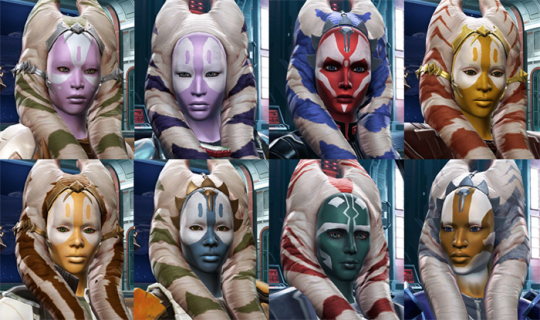
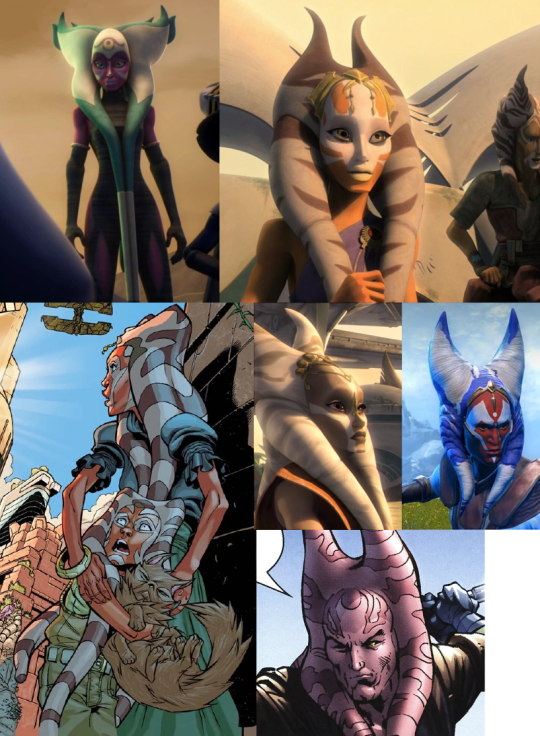
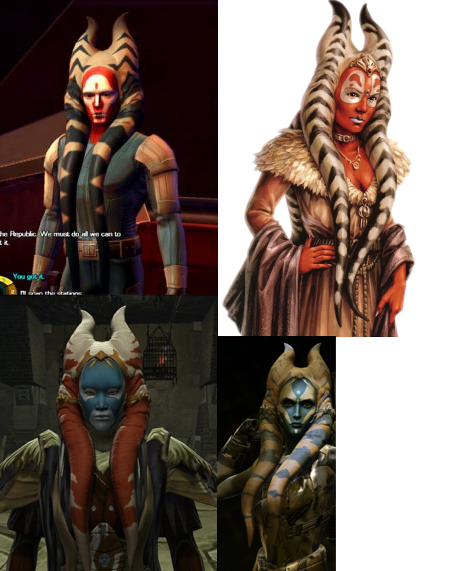
Togrutas are a carnivorous species with a tribal/pack nature. Though it’s seldom shown, it’s mentioned on the wiki that Togrutas actually have sharp canine teeth! Togrutas are distinguished by their varying face/skin patterns, their 3-4 head tails (or Lekku) and their montrals, the hollow horn-like growths on top of their head. Their montrals give them passive echolocation. Their Lekku and Montrals can drastically vary in shape from person to person, and their skin and eye colors can be just about any color of the rainbow.
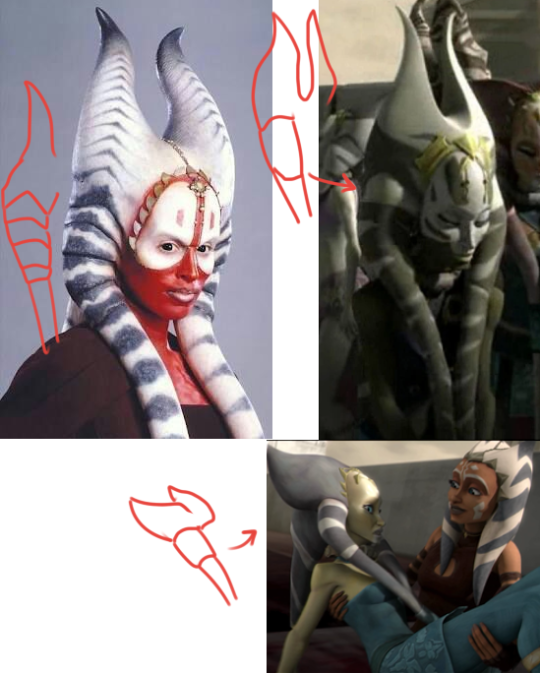
Their head tails and monrtals can be grown in sections, like shown:
Or they can be one continuous growth:
Adult Male Togrutas have been shown to sometimes have shorter Lekku than females-
but not all of them adhere to this. Male’s Lekku can be just as long as a Females and can pretty much be the same shape-
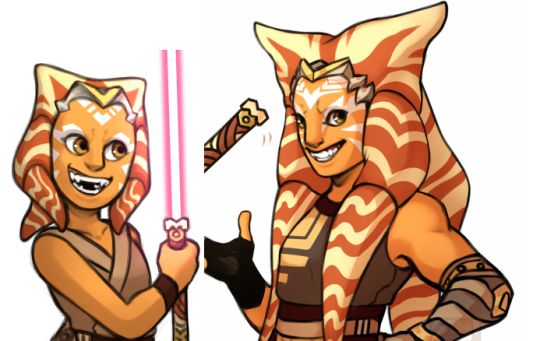
And here’s my fav Male Togruta, Zandar! (character by my friend XombieJunky on deviantart, please go check out his work!) He’s a prime example of Fantastic Togruta, I love him
Togruta montrals and lekku get longer as they grow older, and the pattern can shift and change with time, as well as their face markings shifting in shape-
I’ve exercised this pattern shift with my OC Stitch, you can see how their montrals/lekku grew over time as well-
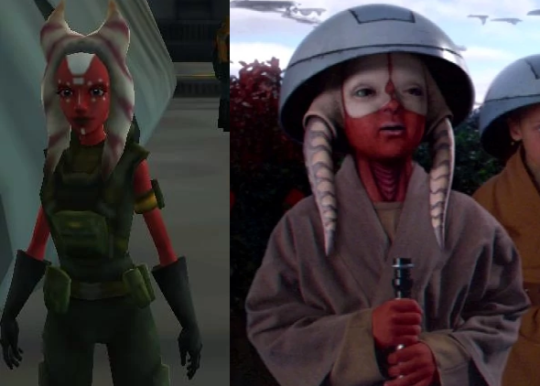
And here’s some more examples of Togruta younglings-
Most examples of Togruta shown have white as a prominent color on their montrals and face, but it’s not necessary to have that (as seen with that pinkish-purple guy shown earlier on this post). With my OC Tulu, I tried to go for a watermelon-like color scheme, she has no white markings-
A cool way to figure out color schemes for a Togruta could be by using a pallet generator, here’s one of my fav generators if you want to use it!
On my final point, I’ll be talking about Togruta headdress. Here’s an excerpt from the wiki on that-
“
As hunters, the Togruta showed off the pelts and teeth of their game as a sign of pride and maturation. Special pride was taken in the teeth of akul that a Togruta had taken down as an individual. These teeth often were made into jewelry such as an akul-tooth headdress or a necklace, which also incorporated metals, stones, and pearls found on Shili.“
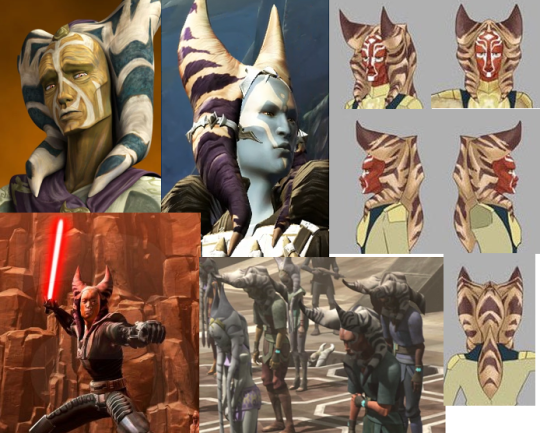
The headdress is mentioned to be made with teeth, but that’s not always necessary. Here’s some headdress examples-
Headdresses are a cultural thing for them and can be fun to design, but it’s not a requirement. Many go without the headdress, it’s up to you!
I believe that should be all the basics of Togruta design. If you need further content, google image search “Togruta” and/or read the wiki for inspiration. Hope this helped at all, and have fun making your Togrutas!
This first post focuses on how medicine is practiced on the battlefield and within various military organizations. The next part will be about civilian medicine and common procedures.
I’ve included both Canon and Legends information, but I’ve distinguished the two where they can’t work together. From here, canon (lowercase) will refer to the new Canon (post-April 2014) and Legends combined. The most prominent and well-known militaries are included in this post; if you don’t see one here, it’s probably because not much information was available and it is a more obscure group. If you would like to know about one that isn’t here, feel free to send an ask.
The rest is under the cut. Sorry if it doesn’t work for mobile users!
Galactic Republic
Within the Grand Army of the Republic, there were several different kinds of medical practitioners. Clone medics and clone medical officers were bred and trained to treat other clones; while clone medics participated in battles with the other clone troopers, medical officers were stationed on Haven-class medical stations, capital ships, and at mobile medcenters, and they wore white uniforms rather than armour. Some medics trained to become a first aid specialist (sometimes abbreviated to FAS), a medic who treated and stabilized injured clones in the middle of a battle.
It is unclear exactly how medics fit into the command structure of the GAR. Some, like Sergeant Coric, had known military titles while others, like Kix, were referred to only as a clone trooper medic. In medical matters, however, medics were known to outrank their commanding officers.
Equipment
Clone medics carried backpacks filled with medical equipment when they went onto the battlefield. They were known to be equipped with two vibroscalpels, two laser cauterizers and a laser scalpel, as well as bandages and various bacta products. Some sources suggest that they carried medpacs, meaning they could also have had medisensors, synthflesh, kolto, spray bandages, hypos, irrigation bulbs, coagulants and various medical drugs on their person. While these supplies allowed the medics to perform basic procedures, medcenters and medbays were relied on for more complete treatment. As a result, on long campaigns or in situations where evacuation could not be provided, medics may be forced to leave badly injured clones behind.
Medical droids were also available to help treat patients. The meddroids used by the Republic during the Clone Wars could be found at any permanent or makeshift medical facility, and sometimes were even set up near the front lines at small mobile aid stations, but they were not generally brought into the actual fighting like the clone medics were due to their restricted mobility. The 2-1B surgical droids and FX-series medical assistant droids were popular models within the Grand Army, and they often worked together with the FX-series as the assistant to the 2-1B. Both could work in tandem with a clone medic/medical officer or a Kaminoan, or perform a medical procedure by themselves. IM-6 meddroids, on the other hand, were able to move into the middle of a fight and drag injured soldiers away for treatment. They were much smaller than the 2-1B and FX-series droids, and hovered on repulsors rather than walking or rolling. They were also very popular in the GAR and could be stationed on anything from Star Destroyers to gunships and walkers. (See links for more specific information on these meddroids).
If a clone survived the initial injury and could be recovered from the battlefield, he was brought to a Republic Mobile Surgical Unit (RMSU). RMSUs were small mobile hospitals, able to be set up or taken down in under an hour, that were located near the fighting and were equipped to either completely heal the injury or keep the clone stable until he could be brought to a medical station. They were staffed by surgeons, medical officers and medical droids, and were theoretically capable of dealing with any injury, as they included equipment such as bacta tanks, antisepsis fields and even cloning tanks to grow replacement organs. However, in reality, they often experienced critical shortages of personnel and supplies.
The injured clone could then be brought by medical frigate to a Haven-class medical station. The Republic commissioned twenty Haven-class medical stations at the beginning of the Clone Wars, one for each Sector Army. They were stationed in space near battlegrounds and could treat nearly 80,000 patients at once. There is little information on what these stations were equipped with in terms of equipment and supplies, but they were staffed by clone medical officers, medical droids and, in at least one case, a Jedi and a Kaminoan.
Two common medical frigates used by the Republic were the MedStar-class and the more heavily armed Pelta-class frigates. These ships often accompanied the rest of the fleet into battle and were equipped to both treat and transport patients, and were staffed by medics and, occasionally, Jedi healers. The frigates were also commonly used to transport supplies between medical stations, larger bases and RMSUs.
In other cases, clones were brought to a medical station by their Star Destroyer. This could be the better option following a battle in space, where injured pilots or crewmembers could be stabilized in the SD’s medbay and transported on one large vessel instead of needing several frigates.
Injured members of planetary defense forces fighting along with the Republic military would likely be dealt with differently, but it is not specified how in canon.
Trade Federation/Separatist Droid Army
The droid army did not employ medics, though they did use the MED-47 and AK-25-MED models of medical droid when dealing with organics. These situations usually involved torture of the opposing side’s soldiers.
Galactic Empire
The medical treatment of Imperial stormtroopers and other soldiers was often very similar to that of the Republic’s clones. Imperial medics and 2-1C medical droids worked in medbays, field hospitals and directly on the battlefield. Medics who were attached to the army, or were currently planetside, wore armour similar to that of an Imperial Army trooper, while those attached to the navy or serving on a ship wore the Imperial Navy crewman’s jumpsuit with backpacks and a hip pack for medical supplies. Those working with the Stormtrooper Corps often wore stormtrooper armour and were called stormtrooper medics, stormmedics or stormsurgeons.
Equipment
A lot of equipment left over from the Republic when it became the Empire continued to be used, including the Republic Mobile Surgical Units (renamed Imperial Mobile Surgical Units), some Pelta-class and MedStar-class medical frigates, and 2-1B and FX-series medical droids. While it is unknown what happened to the surviving Haven-class medical stations after the war, it is possible that they continued to be used as well. In addition to the ships left over from the Republic, the Empire used E-2T medical shuttles, and a variant of the Lambda-class T-5a shuttle called the T-5 Deliverance. The former was used to transport up to twelve Human patients, and the latter would deliver shipments of medical supplies directly to the battlefield.
As a result of the Empire’s tendency to build increasingly massive ships and battlestations, many non-medical vessels also had large medbays. Medics and meddroids alike could be found serving on these ships. However, because it was a large military without a need to be constantly on the move, longer-term medical care was likely conducted primarily in planetside medcenters and other large, permanent facilities. Many temporary Imperial facilities, such as prefabricated garrisons, also housed medical facilities and personnel.
Imperial medics were known to carry medpacs, though it is not known what brand or make they were or what was in them. They likely included vibroscalpels and/or laser scalpels, bacta, laser cauterizers, and bandages, like the clone trooper medics carried. These medics stayed away from the front lines when deployed on the ground. As for meddroids, the 2-1C medical droid was the preferred model of the Empire, as it was designed to operate independently on the battlefield. Though its name suggests a relation to the 2-1B surgical droid, it was actually in the line of FX-series medical assistant droids and had a similar appearance.
Naturally, treatment of Imperial troops followed the same basic process as that of Republic troops. As a general rule, a soldier injured planetside would be given first aid, then brought to a mobile hospital or aid station, then transported to a better-equipped medcenter or a capital ship for recovery, wherever was convenient. Pilots rarely survived to have their injuries treated, as standard TIE fighters did not come with shields.
Alliance to Restore the Republic
Medicine was practiced very differently in the Rebellion, especially in its earlier years. Because it was a highly mobile fighting force, injured soldiers and pilots were often treated on large hospital ships such as the Redemption, a modified escort frigate. It was not uncommon for ships to be modified to make room for medical facilities, and Alliance ships that were designed for medical use were often stolen from the Empire. These ships were staffed mainly by medical droids, as organic medics were usually more valuable on the battlefield. Many planetside bases also had medical facilities, though the hospital ships generally had more equipment available.
Equipment and treatment procedure
The Alliance Navy included several modified EF76 Nebulon-B escort frigates, such as their primary medical frigate, the Redemption, that served as mobile hospitals. These ships could hold and treat 745 patients at a time, and were fitted with state-of-the-art medical equipment including fifteen bacta tanks, multi-species operating theatres, intensive care units, recovery wards, and facilities for non-oxygen breathers such as ammonia chambers. They also had their own blood banks, laboratories and morgue, as well as dedicated space for storing medical equipment and up to 6000 tonnes of medical cargo. Patients were treated by a complement of thirty 2-1B surgical droids and eighty medical staff, and the ship’s main medical computer timed and monitored treatments. It is also possible that at least one Nebulon-B2 frigate was modified for use as a hospital ship. Most patients were treated onboard ships like these.
Sprint-class rescue craft, also called med runners, were used to transport the dead and wounded and respond to distress signals in deep space. They could hold forty patients and were staffed by five medics. The E-50 Landseer, a Corellian shuttle, was repurposed for use as an ambulance ship that could be used to transport medical and repair supplies on the battlefield. Other models of starship, such as the stolen Imperial cruiser Mercy which could treat around 5000 patients and had 4250 bacta tanks, could also be converted to hospital ships. In fact, the majority of Alliance medical craft were repurposed, stolen, or both.
2-1B surgical droids were the best-known medics in the Rebellion. Organic beings did serve as medics, and could be found anywhere the droids could, but they tended to work directly on the battlefield and in other places where the droids couldn’t go. 2-1Bs were seen everywhere from capital ships to personal medbays to planetside bases.
New Republic (Canon and Legends)
When the Alliance was reorganized into the New Republic, remaining medical equipment continued to be used. The philosophy that their personnel were non-dispensable also remained, and so the acquisition and maintenance of medical equipment was given great importance. In both Canon and Legends, not much is known about field medicine in the New Republic, but it can be assumed that it functioned more or less the same as in the Alliance. However, the Legends New Republic spent a lot longer fighting the Imperial Remnant than the Canon New Republic, which then maintained peace for perhaps as long as three decades. Without any known major conflicts between the Galactic Civil War and the First Order-Resistance conflict, and due to the New Republic’s demilitarization efforts, field medicine likely did not play a big role under the Canon New Republic for most of its tenure.
Resistance
As a splinter group of the New Republic military, the Resistance likely did have some access to hospital ships, but acquiring large vessels was very difficult. Most equipment they had was quite old, left over from the days of the Rebellion. Supposedly, medcenters on bases and the medbays of capital ships were the Resistance’s main medical facilities. Like its predecessor, the Rebellion, the small number of personnel meant that high priority was placed on being able to save and heal their troops, suggesting that there existed some sort of battlefield medic within their ranks. If they employed medical droids – likely, given that they employed a large number of other droids in order to keep the organization functioning – they may have used 2-1Bs like the Rebellion.
First Order
Nothing is known specifically about medicine within the First Order, but it can be assumed that they had access to advanced medical technology and facilities due to the size and capability of the rest of their forces.
That’s all for this post! Any terminology used here that isn’t already included in the Vocab List will be added shortly, and the next post will be up as soon as possible.
Does anyone know how to do dates in the Star Wars calendar outside of years? Are there names for standard months? I’ve only managed to find some info on the days of the week so far.
I don’t normally answer questions on other people’s posts, so I hope you don’t mind @operaticspacetrash, but this one is relatively straightforward. Within the Galactic Standard Calendar there are no names for months, and they are known by their number (e.g., Month 5). You probably know that there were many different variants of the calendar, all with different numbers of months in a year, weeks in a month, and days in a week. The GSC consists of 24 hours in a day, 5 days in a week, 7 weeks in a month, and 10 months in a year. These 10 months, plus 3 festival weeks and 3 holidays make up a year with a total of 368 days. In the Old Republic, the Treaty of Coruscant was used as year 0; in the New Republic, it was the Battle of Yavin.
I’m guessing that what you’re wondering about is how to write this out and refer to specific dates, like how we would say [day]/[month]/[year]? This is covered by the Great ReSynchronization. It was a notation system established in 35 BBY which used the format [year]:[month]:[day] to write dates. 35 BBY was the reference point, so, for example, the Jedi Purge occurred in the year 16 and the Battle of Yavin in the year 35. Years before 35 BBY are written with “BrS” (before resynchronization) after the number, so Qui-Gon would have been born in 57 BrS. Adding in the months and days, you get something like the date 13:5:21 (13 years after 35 BBY, on the 21st day of Month 5), on which occurred the First Battle of Geonosis. Much like how we might say “June of 2015” you can omit the day and just write [year]:[month].
This system was used through the Imperial period (though some preferred to use the Empire’s creation as year 0) and was reorganized in 25 ABY into the BBY/ABY system that we often use. Before the Great ReSynchronization and after it was disbanded, there is no canonical system for writing dates. It is possible that the [year]:[month]:[day] format was still used, but this is not confirmable.
You may also want to take a look through my tag on calendars.
For a Padawan to become a Knight, they had to pass the Trials of Knighthood. These tests were administered by the High Council, to Padawans they believed to be ready. While age did not directly play a part in the Council’s decision to have someone take the tests, most Padawans were knighted in their twenties. The Master’s approval was not required, though I believe that they could recommend that their Padawan be tested.
During the Trials of Knighthood, a Padawan had to pass five trials: the Trials of Skill, Courage, Spirit, Flesh, and Insight. If deemed appropriate, the Council may have also substituted tests or waived them if the Padawan had shown the same qualities through their actions. For instance, both Anakin and Obi-Wan became Knights without participating in formal trials.
For the Trial of Skill, one must face a three-part assessment consisting of physical, mental, and combat challenges. The physical challenges were usually tests of strength, endurance, climbing, jumping and the like. The mental challenges were tests of levitation, another endurance test, duress and reflection. For the combat challenges, Padawans completed tests of conflict, duelling, and of the calm mind, and were required to face some sort of adversary. The individual or individuals they face would vary a lot, from holograms to droids to other students, or even the Temple Battlemaster or Grand Master. Some students may fight many opponents using many different weapons or altering the appearance of the chamber or their perception. While the tests largely consisted of physical feats, the Battlemaster looked more for the ability of a Padawan to use discipline and focus to avoid distraction. Anakin completed this trial when he defeated Asajj Ventress in combat.
Less is known about the Trial of Courage. In order for the test to work, the student must not know beforehand what they will face. Before the Golden Age of the Republic, courage on the battlefield or facing a Sith was considered a good way to pass the trial, but later tests were largely simulated. The Council could also send a student on a real mission; these missions had the potential to be deadly, which is why only students who are ready may participate in the Trials. When Obi-Wan defeated Darth Maul on Naboo, the Council considered that his Trial of Courage.
The Trial of the Spirit was a test of self-discovery. A Padawan entered a deep meditative trance and confronted their deepest fears and the darkness within themselves. Such deep meditation could be very dangerous, so a Master was always present to help guide the student back to the present. Unlike other tests, the High Council did not dictate what would happen and the student would have to decide what to do on their journey. This test had the potential to be highly traumatising, and some students would wake from a failed test inconsolable.
The Trial of the Flesh was considered the hardest test of the five, and it involved the Padawan experiencing great physical pain, loss, or hardship. In the earlier days of the Republic, the students were subjected to bursts of electricity applied directly to the skin, but this practice was abandoned. During the New Sith Wars, battle scars and lost limbs were often accepted as a way to pass the test. It was not uncommon for a Padawan to pass the Trials of the Flesh, Skill and Courage at the same time by defeating a Sith on the battlefield. Later, the separation of the Master-Padawan pair as the Padawan became a Knight was considered a hardship enough to pass the test, but during the Clone Wars it was once again common to pass through physical injury and loss.
The Trial of Insight was a test that required the Padawan to use the Force to see through deception. To pass, they were forbidden to study any possible challenges in the Archives, as they had to complete it themselves. The Trial sometimes took the form of riddles and puzzles, such as being required to solve the High Riddles of Dwartii. Other known scenarios are having to find one grain of sand among a field of rocks, or being faced with an army of holograms and forced to see through the illusion.
If a Padawan passed all these tests in one way or another, their Master would then prepare them for the Knighting Ceremony. If they failed, they had the opportunity to take them again until they passed. Before the ceremony, the student would meditate in the preparation room in the Tranquility Spire for a whole day. The next day, they would go up to the next level of the Tower, called the Hall of Knighthood. There, they would kneel in front of the Grand Master, the members of the High Council (if the High Council was unavailable, members of the other two Councils would step in), and other Jedi who were influential in the Padawan’s journey. The present Masters would ignite their lightsabers in a circle around the apprentice, and the Grand Master would lower their lightsaber to just above each of the student’s shoulders before severing their braid. The new Knight would then take their braid and leave the Hall in silence.
During Kanan’s knighting during a vision in the Lothal Jedi Temple, the words said were, “By the right of the Council, by the will of the Force, Kanan Jarrus, you may rise.” This may have also been said during more orthodox ceremonies, or another similar phrase.
After how popular the first iteration of this flowchart got (thank you all so much for that, by the way, it’s really awesome that it helped so many people out), I was inspired to create a second volume, with even more species and resources than the first. Well, after a month or so of work, it’s finally here! Just in time for the 40th Anniversary of Star Wars: A New Hope, here’s “What Species To Choose For Your Star Wars OC: Volume 2″!
For this new version, I upped the ante with everything. I went from including 75 species to a whopping 150 (which is still only scratching the surface of the full list, I’m afraid), and I tried my best to include more species from “The Clone Wars”, “The Force Awakens”, and “Rogue One” as well. Not only that, but down below I’ve included more resources as well: in addition to each species’ Wookieepedia articles, I’ve provided (where available) videos of the species in action, informational videos, and name generators, all to give you as much info as possible for your OC. Furthermore, among some other minor formatting tweaks, I’ve also added the option to choose answers via dice rolls (thanks to @empress-only-in-name for that idea), for anyone who would prefer a more random choice in species. Finally, I think it’s also worth mentioning that the wonderful @pomrania re-created the flowchart in a text-based format here, if you’d like to check that out.
Let me know what you all think of the new version! I tried my best to take into account everyone’s requests and suggestions, so hopefully it all worked out to your liking! Do let me know if there’s anything I can add or change, though; it will be a while before I make a Volume 3, if ever, but I’d be happy to tweak this version if it helps. Also, if you end up using this to make a character, please consider either tagging me or using #StarWarsOCFlowchart so I can see it; I don’t care about getting credit or anything, I just want to see what you guys come up with!
But yeah, I think that’s all I have to mention! I hope this helps some people out!
What a coincidence, I’ve been researching the exact same thing! Unfortunately, the options are a bit limited.
Corellia is one world that’s relatively close to Devaron. Technically it was neutral during the early days of the Clone Wars, but did later supply the Republic with ships and weapons. It was pretty much self-governing during the reign of the Empire; while it was under Imperial jurisdiction and had a Moff assigned to it, the citizens were generally quite anti-Imperial.
Atzerri, much closer than Corellia, was neutral during the Clone Wars and later worked against the Empire. Nearby, the planet Kooriva was a planet aligned with the Corporate Alliance that joined the CIS and was eventually taken over by the Republic. It was then punished by the Empire for being involved with the Separatists.
Fondor was a shipyard world that was technically part of the CIS during the Clone Wars, but its population didn’t really support it and didn’t contribute much to the war effort. It was not particularly supportive of the Empire either, but was forced to do major work such as the ship Executor.
Thyferra was the location of a base for the Third Fleet of the Confederate Navy. While the planet was affiliated with the CIS, it appears that it was functionally neutral because the Republic was still able to acquire bacta through the Clone Wars. After the war, its two major bacta companies supplied the Empire’s bacta, though the Rebel Alliance also had a supplier on-world.
That’s about all the major/known planets that would fit. Hopefully one of these work for you!
You’ll be happy to know, anon, that you have 185 options! Here is the list of planets, both Legends and canon, that are classified as ice worlds.
Obviously that’s a lot to choose from. If you’d rather use a canon planet, you could try one of these (I’ve linked their Wookieepedia articles): Ando Prime, Orto Plutonia, Nelvaan, Rhen Var, Rinn, Toola, and Ilum. There is also Starkiller Base, but I figure that probably wouldn’t work for any characters outside the First Order. Beyond that, it may be hard to quickly break down that list any further.
Depending on your specific scenario, one of these many, many planets might work better than the others. If you’re looking for something more specific (like a smuggler’s haven, an unpopulated world, planets associated with the Republic or the Separatists or the Empire, etc.), feel free to send another ask and I can help you sort through that list.
There are several known types, but some only work on specific species. There are also some substances that are not poisons but can be used as such (some coolants and fuels are toxic to near-humans, many common foodstuffs are toxic to one species or another). I’ve picked some more common substances that could be/are used as poisons and organized them by type.
Venoms: Worrt venom, krayt dragon venom (used as a poison in powder form), chuba poison (causes strokes), Kodashi viper venom (found only on Dathomir; there are no known instances of it being harvested from the snakes), rock wart sting juice (used in powdered form), Quesh venom, Dozoisian Snark Venom (lethal to humans, used by mixing with liquids).
Biotoxins: Irksh poison (used by the Yuuzhan Vong), Sith poison (not lethal, but used to make the victim unable to resist the dark side of the Force), mycotoxin (made from cerulean slime mold).
Actual real poisons: Synox (colourless, odourless and tasteless), the unknown poison used in the assassination of Onaconda Farr, dioxis (the gas Nute Gunray used in TPM to try to kill Obi-Wan and Qui-Gon), KillTab (a method of execution), teccitin (used by the Empire before 0 BBY), toxical (extremely deadly and fast-acting), malkite themfar (a neurotoxin used by bounty hunters), suicide pills.
Things that aren’t really poisons: Cyanoxis D-587 (intended to kill conduit worms), Cyclone (intended as a stimulant, used during the Cold War), insecticides (intended for pests, deadly to insectoid species), silicartha (used on Tatooine to kill small pests), hydrogen cyanide (a gas that happens to be fatal to humanoids), coolants.
Keep in mind that some of these are only (as far as we know) used in specific eras or by specific people/groups. Feel free to ask for more information about a specific substance or type of substance, especially if you need a poison to act against a non-humanoid being.
Thank you! There are quite a few different kinds of torture devices in the Star Wars universe, so all lumped together they would simply be called torture devices (alternatively, torture technology). Probably the most common device specifically used for torture would be the torture droid, sometimes interchangeably referred to as an interrogation droid. There are a few different types, so I’ll direct you to the Wookieepedia page in case you’d like to look at them.
A lot of other torture methods involve things not really meant for torture. Several times throughout the prequels and The Clone Wars, electrostaves and other electricity-based weapons are used as impromptu torture devices. There are instances of vibroweapons, lightsabers and other bladed/cutting weapons being used. There are even Force techniques that can be used to cause a person extreme pain, physical damage, and a very nasty death. On the less gore-y side, there are also aa few technologies and drugs used to artificially induce pain, confusion, immobility or hallucinations. Here’s a list of a bunch of different torture technologies; the article on torture includes Force powers and devices not meant for torture (be warned, you may find some of these disturbing). Basically, if you need a specific device then you have a lot of options.





 Write Better Star Wars
