Sure! Togrutas are my fav SW species, I’ll see if I can do them any justice here! I can already tell this one will be very long so i apologize in advance lol
I’ll be paraphrasing from there for most anatomy references.
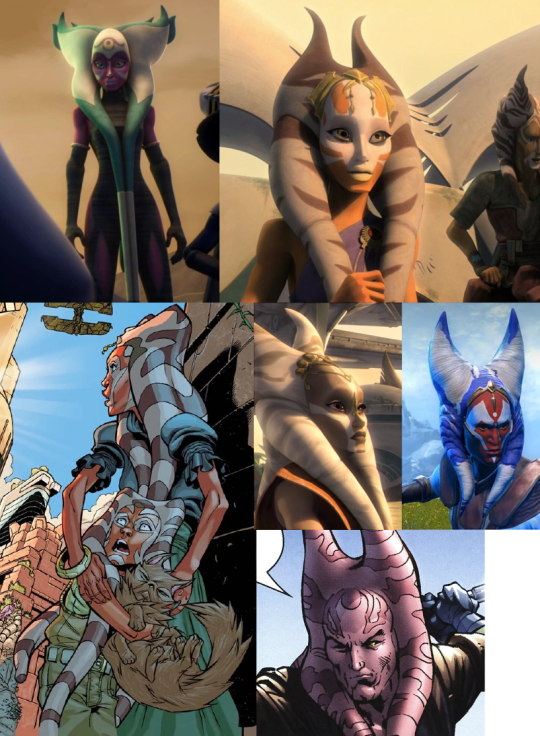
Togrutas are a carnivorous species with a tribal/pack nature. Though it’s seldom shown, it’s mentioned on the wiki that Togrutas actually have sharp canine teeth! Togrutas are distinguished by their varying face/skin patterns, their 3-4 head tails (or Lekku) and their montrals, the hollow horn-like growths on top of their head. Their montrals give them passive echolocation. Their Lekku and Montrals can drastically vary in shape from person to person, and their skin and eye colors can be just about any color of the rainbow.
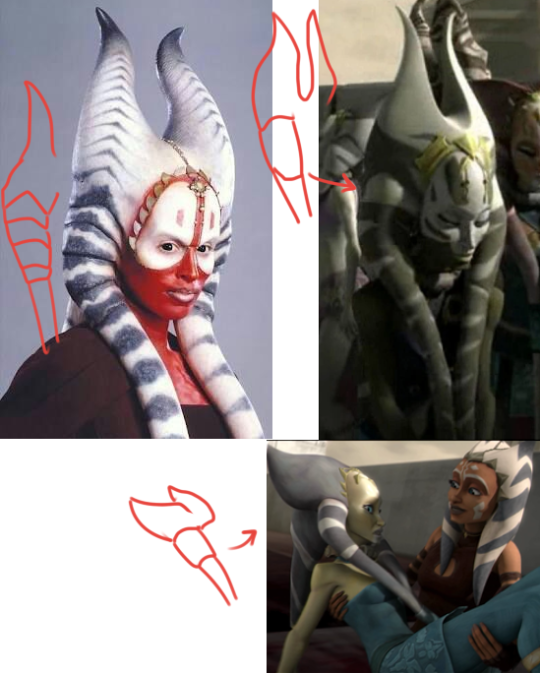
Their head tails and monrtals can be grown in sections, like shown:
Or they can be one continuous growth:
Adult Male Togrutas have been shown to sometimes have shorter Lekku than females-
but not all of them adhere to this. Male’s Lekku can be just as long as a Females and can pretty much be the same shape-
And here’s my fav Male Togruta, Zandar! (character by my friend XombieJunky on deviantart, please go check out his work!) He’s a prime example of Fantastic Togruta, I love him
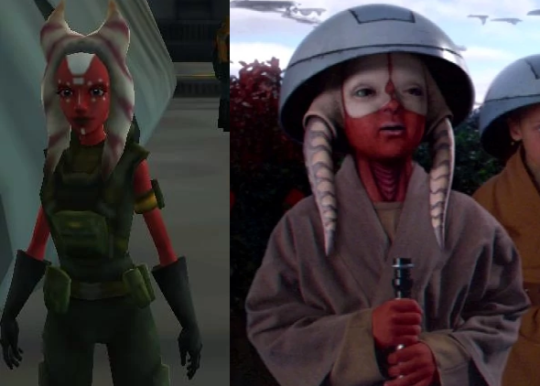
Togruta montrals and lekku get longer as they grow older, and the pattern can shift and change with time, as well as their face markings shifting in shape-
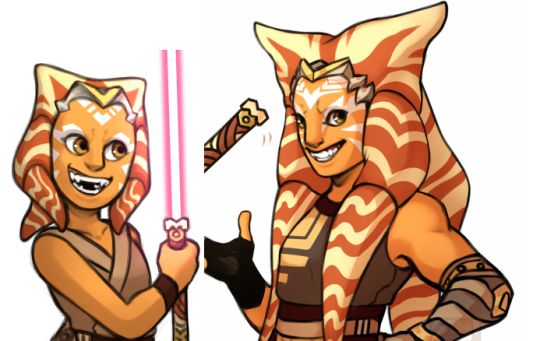
I’ve exercised this pattern shift with my OC Stitch, you can see how their montrals/lekku grew over time as well-
And here’s some more examples of Togruta younglings-
Most examples of Togruta shown have white as a prominent color on their montrals and face, but it’s not necessary to have that (as seen with that pinkish-purple guy shown earlier on this post). With my OC Tulu, I tried to go for a watermelon-like color scheme, she has no white markings-
A cool way to figure out color schemes for a Togruta could be by using a pallet generator, here’s one of my fav generators if you want to use it!
On my final point, I’ll be talking about Togruta headdress. Here’s an excerpt from the wiki on that-
“
As hunters, the Togruta showed off the pelts and teeth of their game as a sign of pride and maturation. Special pride was taken in the teeth of akul that a Togruta had taken down as an individual. These teeth often were made into jewelry such as an akul-tooth headdress or a necklace, which also incorporated metals, stones, and pearls found on Shili.“
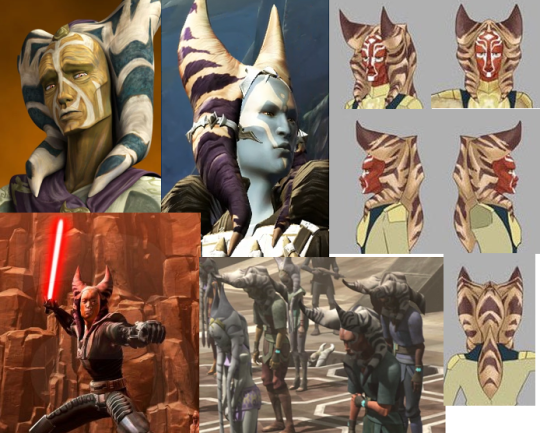
The headdress is mentioned to be made with teeth, but that’s not always necessary. Here’s some headdress examples-
Headdresses are a cultural thing for them and can be fun to design, but it’s not a requirement. Many go without the headdress, it’s up to you!
I believe that should be all the basics of Togruta design. If you need further content, google image search “Togruta” and/or read the wiki for inspiration. Hope this helped at all, and have fun making your Togrutas!
I don’t see why not. If they can be ridden and used as labour animals there probably isn’t anything preventing it, though I don’t believe this has been done in canon so I couldn’t tell you with certainty.
I am not terribly familiar with the character myself, I haven’t read the X-Wing books in a while, but there is no indication on his Wookieepedia page that we know what he did before joining the Rebellion. I doubt you’ll run into any conflicts, but if any of my followers who have read the series more recently could confirm or deny that, it would be great.
To my knowledge, no same-sex marriage has canonically occurred between citizens of the Republic or the Empire. I cannot seem to find any mention of it as a law. It would be impossible to make a comparison.
However, the complete lack of representation can be turned around to mean that same-sex relationships are seen as so unremarkable that they warrant no legal mention. I personally find it hard to believe that the Empire would waste time officially going after marriage rights when they were already busy with nonhumans, but at this point it’s the writer’s choice.
The ingredients are not known, and I’m not sure I could tell you for certain whether a Human could drink it. I’m not a biologist, but I don’t believe the temperature would be an actual problem, though it would probably be uncomfortable. Humans can eat ice cubes, and can breathe air below zero degrees, so I think he could drink it safely.
~ Jacen
Probably not, actually, given that that temperature would make any liquid a human could consume frozen solid. If it’s still drinkable at that temperature, it’s probably got something in it that isn’t good for humans.
Warm-blooded beings are able to drink it, though most can’t enjoy it because of the temperature, so humanoids are probably not exempt. Alcohol alone lowers the melting point significantly so any additional chemicals in the drink are probably found in small quantities. Most likely, the worst thing in the drink for humanoids is the ethanol itself.
The ingredients are not known, and I’m not sure I could tell you for certain whether a Human could drink it. I’m not a biologist, but I don’t believe the temperature would be an actual problem, though it would probably be uncomfortable. Humans can eat ice cubes, and can breathe air below zero degrees, so I think he could drink it safely.
Shesharillian vodka is definitely the closest, but it’s pretty obscure as canon goes. You could also use other potent distilled alcohols that aren’t actually called vodka, such as Twi’lek liquor or Kyrf.
This first post focuses on how medicine is practiced on the battlefield and within various military organizations. The next part will be about civilian medicine and common procedures.
I’ve included both Canon and Legends information, but I’ve distinguished the two where they can’t work together. From here, canon (lowercase) will refer to the new Canon (post-April 2014) and Legends combined. The most prominent and well-known militaries are included in this post; if you don’t see one here, it’s probably because not much information was available and it is a more obscure group. If you would like to know about one that isn’t here, feel free to send an ask.
The rest is under the cut. Sorry if it doesn’t work for mobile users!
Galactic Republic
Within the Grand Army of the Republic, there were several different kinds of medical practitioners. Clone medics and clone medical officers were bred and trained to treat other clones; while clone medics participated in battles with the other clone troopers, medical officers were stationed on Haven-class medical stations, capital ships, and at mobile medcenters, and they wore white uniforms rather than armour. Some medics trained to become a first aid specialist (sometimes abbreviated to FAS), a medic who treated and stabilized injured clones in the middle of a battle.
It is unclear exactly how medics fit into the command structure of the GAR. Some, like Sergeant Coric, had known military titles while others, like Kix, were referred to only as a clone trooper medic. In medical matters, however, medics were known to outrank their commanding officers.
Equipment
Clone medics carried backpacks filled with medical equipment when they went onto the battlefield. They were known to be equipped with two vibroscalpels, two laser cauterizers and a laser scalpel, as well as bandages and various bacta products. Some sources suggest that they carried medpacs, meaning they could also have had medisensors, synthflesh, kolto, spray bandages, hypos, irrigation bulbs, coagulants and various medical drugs on their person. While these supplies allowed the medics to perform basic procedures, medcenters and medbays were relied on for more complete treatment. As a result, on long campaigns or in situations where evacuation could not be provided, medics may be forced to leave badly injured clones behind.
Medical droids were also available to help treat patients. The meddroids used by the Republic during the Clone Wars could be found at any permanent or makeshift medical facility, and sometimes were even set up near the front lines at small mobile aid stations, but they were not generally brought into the actual fighting like the clone medics were due to their restricted mobility. The 2-1B surgical droids and FX-series medical assistant droids were popular models within the Grand Army, and they often worked together with the FX-series as the assistant to the 2-1B. Both could work in tandem with a clone medic/medical officer or a Kaminoan, or perform a medical procedure by themselves. IM-6 meddroids, on the other hand, were able to move into the middle of a fight and drag injured soldiers away for treatment. They were much smaller than the 2-1B and FX-series droids, and hovered on repulsors rather than walking or rolling. They were also very popular in the GAR and could be stationed on anything from Star Destroyers to gunships and walkers. (See links for more specific information on these meddroids).
If a clone survived the initial injury and could be recovered from the battlefield, he was brought to a Republic Mobile Surgical Unit (RMSU). RMSUs were small mobile hospitals, able to be set up or taken down in under an hour, that were located near the fighting and were equipped to either completely heal the injury or keep the clone stable until he could be brought to a medical station. They were staffed by surgeons, medical officers and medical droids, and were theoretically capable of dealing with any injury, as they included equipment such as bacta tanks, antisepsis fields and even cloning tanks to grow replacement organs. However, in reality, they often experienced critical shortages of personnel and supplies.
The injured clone could then be brought by medical frigate to a Haven-class medical station. The Republic commissioned twenty Haven-class medical stations at the beginning of the Clone Wars, one for each Sector Army. They were stationed in space near battlegrounds and could treat nearly 80,000 patients at once. There is little information on what these stations were equipped with in terms of equipment and supplies, but they were staffed by clone medical officers, medical droids and, in at least one case, a Jedi and a Kaminoan.
Two common medical frigates used by the Republic were the MedStar-class and the more heavily armed Pelta-class frigates. These ships often accompanied the rest of the fleet into battle and were equipped to both treat and transport patients, and were staffed by medics and, occasionally, Jedi healers. The frigates were also commonly used to transport supplies between medical stations, larger bases and RMSUs.
In other cases, clones were brought to a medical station by their Star Destroyer. This could be the better option following a battle in space, where injured pilots or crewmembers could be stabilized in the SD’s medbay and transported on one large vessel instead of needing several frigates.
Injured members of planetary defense forces fighting along with the Republic military would likely be dealt with differently, but it is not specified how in canon.
Trade Federation/Separatist Droid Army
The droid army did not employ medics, though they did use the MED-47 and AK-25-MED models of medical droid when dealing with organics. These situations usually involved torture of the opposing side’s soldiers.
Galactic Empire
The medical treatment of Imperial stormtroopers and other soldiers was often very similar to that of the Republic’s clones. Imperial medics and 2-1C medical droids worked in medbays, field hospitals and directly on the battlefield. Medics who were attached to the army, or were currently planetside, wore armour similar to that of an Imperial Army trooper, while those attached to the navy or serving on a ship wore the Imperial Navy crewman’s jumpsuit with backpacks and a hip pack for medical supplies. Those working with the Stormtrooper Corps often wore stormtrooper armour and were called stormtrooper medics, stormmedics or stormsurgeons.
Equipment
A lot of equipment left over from the Republic when it became the Empire continued to be used, including the Republic Mobile Surgical Units (renamed Imperial Mobile Surgical Units), some Pelta-class and MedStar-class medical frigates, and 2-1B and FX-series medical droids. While it is unknown what happened to the surviving Haven-class medical stations after the war, it is possible that they continued to be used as well. In addition to the ships left over from the Republic, the Empire used E-2T medical shuttles, and a variant of the Lambda-class T-5a shuttle called the T-5 Deliverance. The former was used to transport up to twelve Human patients, and the latter would deliver shipments of medical supplies directly to the battlefield.
As a result of the Empire’s tendency to build increasingly massive ships and battlestations, many non-medical vessels also had large medbays. Medics and meddroids alike could be found serving on these ships. However, because it was a large military without a need to be constantly on the move, longer-term medical care was likely conducted primarily in planetside medcenters and other large, permanent facilities. Many temporary Imperial facilities, such as prefabricated garrisons, also housed medical facilities and personnel.
Imperial medics were known to carry medpacs, though it is not known what brand or make they were or what was in them. They likely included vibroscalpels and/or laser scalpels, bacta, laser cauterizers, and bandages, like the clone trooper medics carried. These medics stayed away from the front lines when deployed on the ground. As for meddroids, the 2-1C medical droid was the preferred model of the Empire, as it was designed to operate independently on the battlefield. Though its name suggests a relation to the 2-1B surgical droid, it was actually in the line of FX-series medical assistant droids and had a similar appearance.
Naturally, treatment of Imperial troops followed the same basic process as that of Republic troops. As a general rule, a soldier injured planetside would be given first aid, then brought to a mobile hospital or aid station, then transported to a better-equipped medcenter or a capital ship for recovery, wherever was convenient. Pilots rarely survived to have their injuries treated, as standard TIE fighters did not come with shields.
Alliance to Restore the Republic
Medicine was practiced very differently in the Rebellion, especially in its earlier years. Because it was a highly mobile fighting force, injured soldiers and pilots were often treated on large hospital ships such as the Redemption, a modified escort frigate. It was not uncommon for ships to be modified to make room for medical facilities, and Alliance ships that were designed for medical use were often stolen from the Empire. These ships were staffed mainly by medical droids, as organic medics were usually more valuable on the battlefield. Many planetside bases also had medical facilities, though the hospital ships generally had more equipment available.
Equipment and treatment procedure
The Alliance Navy included several modified EF76 Nebulon-B escort frigates, such as their primary medical frigate, the Redemption, that served as mobile hospitals. These ships could hold and treat 745 patients at a time, and were fitted with state-of-the-art medical equipment including fifteen bacta tanks, multi-species operating theatres, intensive care units, recovery wards, and facilities for non-oxygen breathers such as ammonia chambers. They also had their own blood banks, laboratories and morgue, as well as dedicated space for storing medical equipment and up to 6000 tonnes of medical cargo. Patients were treated by a complement of thirty 2-1B surgical droids and eighty medical staff, and the ship’s main medical computer timed and monitored treatments. It is also possible that at least one Nebulon-B2 frigate was modified for use as a hospital ship. Most patients were treated onboard ships like these.
Sprint-class rescue craft, also called med runners, were used to transport the dead and wounded and respond to distress signals in deep space. They could hold forty patients and were staffed by five medics. The E-50 Landseer, a Corellian shuttle, was repurposed for use as an ambulance ship that could be used to transport medical and repair supplies on the battlefield. Other models of starship, such as the stolen Imperial cruiser Mercy which could treat around 5000 patients and had 4250 bacta tanks, could also be converted to hospital ships. In fact, the majority of Alliance medical craft were repurposed, stolen, or both.
2-1B surgical droids were the best-known medics in the Rebellion. Organic beings did serve as medics, and could be found anywhere the droids could, but they tended to work directly on the battlefield and in other places where the droids couldn’t go. 2-1Bs were seen everywhere from capital ships to personal medbays to planetside bases.
New Republic (Canon and Legends)
When the Alliance was reorganized into the New Republic, remaining medical equipment continued to be used. The philosophy that their personnel were non-dispensable also remained, and so the acquisition and maintenance of medical equipment was given great importance. In both Canon and Legends, not much is known about field medicine in the New Republic, but it can be assumed that it functioned more or less the same as in the Alliance. However, the Legends New Republic spent a lot longer fighting the Imperial Remnant than the Canon New Republic, which then maintained peace for perhaps as long as three decades. Without any known major conflicts between the Galactic Civil War and the First Order-Resistance conflict, and due to the New Republic’s demilitarization efforts, field medicine likely did not play a big role under the Canon New Republic for most of its tenure.
Resistance
As a splinter group of the New Republic military, the Resistance likely did have some access to hospital ships, but acquiring large vessels was very difficult. Most equipment they had was quite old, left over from the days of the Rebellion. Supposedly, medcenters on bases and the medbays of capital ships were the Resistance’s main medical facilities. Like its predecessor, the Rebellion, the small number of personnel meant that high priority was placed on being able to save and heal their troops, suggesting that there existed some sort of battlefield medic within their ranks. If they employed medical droids – likely, given that they employed a large number of other droids in order to keep the organization functioning – they may have used 2-1Bs like the Rebellion.
First Order
Nothing is known specifically about medicine within the First Order, but it can be assumed that they had access to advanced medical technology and facilities due to the size and capability of the rest of their forces.
That’s all for this post! Any terminology used here that isn’t already included in the Vocab List will be added shortly, and the next post will be up as soon as possible.
While the Empire was known for being loose with harsh punishments such as execution, slave work and life sentences, these were typically given to individuals who committed major crimes such as treason and sedition. More minor crimes, and those that cannot be viewed as an attack against Imperial society or any of its high-ranking members, were not prosecuted as harshly. As many member worlds retained their sovereignty under the Empire, crimes that weren’t against the Empire could be dealt with on-world without involving outside authorities. I cannot recall anyone being sentenced for as short as one or two years, as most stories involving the Empire don’t focus on the average civilian or petty criminal, but theoretically it is possible.







 Write Better Star Wars